Why Overleveling combines publishing with player tools
Players ask two different kinds of question. One is answered once; the other is checked again and again. Building for only one of them leaves the other unserved.
- Overleveling
- 4 min read
- Company
Most gaming questions fall into one of two shapes, and the difference between them decides what you should build.
The first shape is a question asked once. A patch lands and changes how a weapon behaves. A new mode arrives and nobody knows the rules yet. Someone gets stuck on a quest step at eleven at night and needs the answer in the next two minutes. These questions are urgent, specific, and finished once they are answered. An article is the right product: it can explain context, show the reasoning, and be read start to finish.
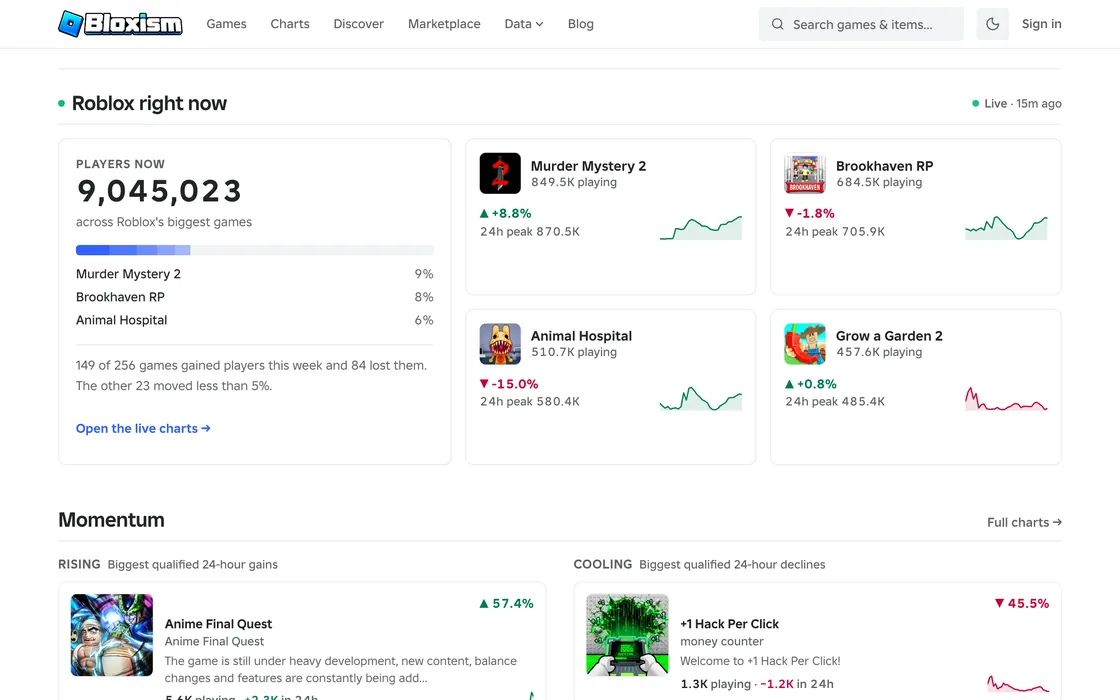
The second shape is a question asked continuously. What is strong right now. What does this item trade for. Which map is in rotation. What does my deck look like against the field this week. The answer has a shelf life measured in days, sometimes hours, and the player will be back to ask again. An article is the wrong product here — it goes stale between visits, and rewriting it every week is a treadmill that eventually loses.
Publishing alone leaves the second question unanswered
A publication that only writes articles ends up trying to serve recurring demand with a format that cannot hold it. The symptoms are familiar to anyone who reads gaming sites: tier lists with a date in the headline and no visible update history, "best loadout" pages that quietly rot, and a reader who has learned not to trust any of it because they have been burned by a stale page before.
The honest answer to a recurring question is not a better article. It is a product that recomputes.
Tools alone struggle to be found
The mirror-image failure is a genuinely good tool that nobody discovers. Databases, calculators and interactive maps are hard to describe in a search result. They answer a question the player has not learned to phrase yet. Someone searching for help with a specific quest step does not know that a full interactive map exists, and the tool has no natural way to tell them.
Publishing solves that. The article that answers the immediate question is also the introduction to the product that answers the next fifty. That is not a growth trick; it is the correct order of operations for a reader who arrived with one problem and did not know the rest existed.
What each half gives the other
- Publishing surfaces demand. What people search for, what they ask after a patch, and which explanations keep getting requested are the clearest signal available about what is worth building.
- Products deepen the answer. Once a question is asked every week by many people, it deserves something that stays current on its own rather than an article somebody has to remember to revise.
- Editorial standards keep the data honest. A database with no sourcing, no version and no correction path is a confident-looking guess.
- Product thinking keeps the writing useful. Knowing what the tools can already answer stops articles from restating a table badly.
Why one network rather than one site
A single general-purpose gaming site has to flatten every audience into one voice, one navigation and one set of assumptions. The player who wants a competitive shooter breakdown and the player checking an item value before a trade are not the same person, are not in the same mood, and are not well served by the same homepage.
Separate brands let each property be shaped by its own community and its own game. What they share is not a template — it is the underlying standards: how sources are handled, how corrections work, how freshness is shown, how commercial relationships are disclosed, and how the software is built and kept accessible. Those things get better across the whole network at once, which is the actual argument for operating a network rather than a portfolio of unrelated sites.