An operator, not a content factory.
Overleveling builds and runs nine gaming properties. Publishing on one side, databases and player tools on the other, and one set of standards and engineering underneath all of them.
One big gaming site is easier to sell and worse for almost everyone who arrives.
The instinct in gaming media is to build one large general site and point every audience at it. It is easier to staff, easier to explain and easier to put on a rate card. It also means a player looking for a competitive shooter breakdown and a player checking an item value before a trade land on the same homepage, in the same voice, ranked by the same editor.
So we build focused properties instead — nine of them — each shaped by one game or platform and the community around it. Each one gets to have its own scope, its own tone, and its own idea of what a good page looks like.
What makes that a network rather than a portfolio is everything underneath: the data pipelines, the editorial standards, the design system, the accessibility work, and the engineering that keeps a database honest when a patch invalidates half of it overnight. Built once, improved for every property at the same time.
We are set up to operate properties for a long time rather than to launch and flip them. That decides what we invest in — structured data, tooling and trust compound; traffic spikes do not.
Four capabilities, each one built on the last.
Nothing here was bought in. Each layer exists because the layer under it made it cheap enough to build for every property at once.
Editorial publishing
Guides, updates, codes, recommendations and analysis written for players who arrived with a specific question and want it answered without wading.
Structured game data
Databases, wikis and reference systems that model a game’s actual structure — items, maps, quests, moves, factions — rather than describing it in prose and hoping.
Player-facing tools
Calculators, builders, planners, trackers and interactive maps: the things a player opens repeatedly because the answer changes and the tool keeps up.
Shared product and technology
The engineering, design, data pipelines and standards underneath all of it, built once and improved for every brand at the same time.
What a property gets by being here rather than alone.
The argument for joining a network is that somebody else has already solved the boring, expensive parts. These are those parts.
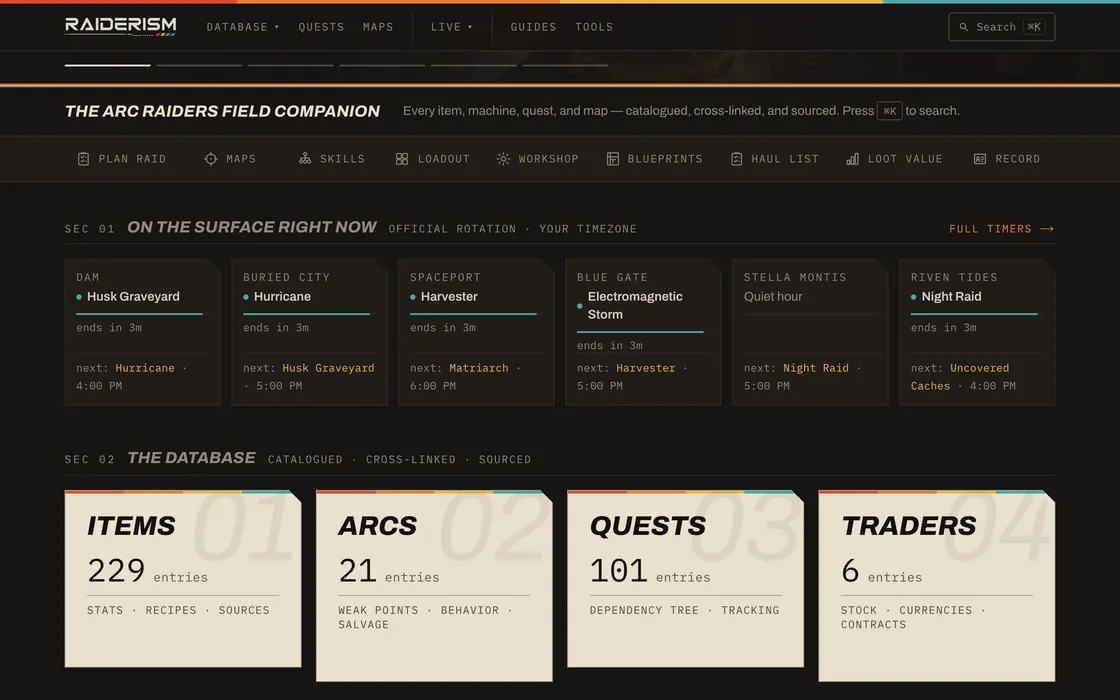

Sourced, versioned data and live timers — the shared pipeline doing the work on one property.
Data pipelines and versioning
Ingestion, scheduled recomputation and version stamping, so a patch is a job that runs rather than a week of manual edits across nine sites.
Editorial standards and corrections
One set of rules on sourcing, verification, disclosure and how a mistake gets fixed in public, applied across every property.
Design system and accessibility
Shared components, contrast and focus rules, keyboard behaviour and reduced-motion support, so accessibility is inherited rather than retrofitted per site.
Search and structured data
Metadata, canonical rules, schema and internal linking handled as engineering, so an editor is not asked to be an SEO specialist as well.
Platform and delivery
Hosting, caching, build tooling and monitoring on one stack, so a performance improvement made once is a performance improvement everywhere.
Commercial and partnerships
One route in for advertisers, publishers and data partners, and one place that knows which properties actually fit a brief.
What every property is held to.
The same four principles the whole network runs on, in full.
Player utility first
Every page should help someone make a decision, understand a system, or play with more confidence.
A page that exists only to occupy a search result is a page we should not have published. The test is concrete: after reading this, can someone choose better, understand something they did not, or play with more confidence? If the honest answer is no, the right move is to cut it or rebuild it as something that does — usually a tool rather than another article.
Current by design
Living games require versioned data, visible freshness, and reliable update workflows.
Live games rewrite their own facts. That makes staleness a design problem rather than a maintenance chore: game version belongs in the data model, recomputing after a patch has to be routine, and what a page covers and when it was last updated has to be visible on the page itself. Where something has gone out of date, saying so is better than a confident number from three patches ago.
Sources matter
Methodology, citations, corrections, and disclosure are part of the product.
How we know something is as much a part of the page as what we know. Different sources carry different weight — official patch notes, values read from the game, aggregated play data, community testing and datamined builds are not interchangeable, and presenting them as though they were is a quiet form of inaccuracy. Corrections are published rather than silently swapped in, and commercial relationships are labelled where they occur.
Independent brands, shared standards
Each property serves its own community while benefiting from one operating network.
Voice, scope and product direction belong to each brand and the community it serves — a shooter audience and a Pokémon audience should not be spoken to identically. What is shared is the floor beneath all of them: verification, attribution, corrections, disclosure, accessibility and the engineering that makes those cheap enough to actually follow.
We would rather hear from you before there is a listing.
There is no careers page, because there are no open listings and an empty one is worse than none. That is not the same as not hiring: the writers, editors, engineers, data people and designers we work with have almost always arrived by introducing themselves first.
If you play one of these games seriously and have opinions about what its coverage gets wrong, that is a more useful opening than a CV. Tell us which property, what you would change, and what you would want to work on.
Get in touch and choose the contributor route.
Whether you are planning a campaign, hold data worth connecting, operate a property you are thinking about the next stage for, or want to write and build with us.